
By Anne Z. Cockerham, PhD, CNM, WHNP-BC, CNE, FACNM
Frontier Nursing University Professor
Holding on to the Star: Celebrating 100 Years of the Frontier Nursing Service is a three-part series covering the history of Frontier Nursing University. In this series, we explore the Frontier Nursing Service’s history from 1925 to 2025 through a chronological journey, highlighting the enduring themes that capture both the core mission that FNS stakeholders have consistently embraced, and the many ways that the service has changed. Read part 1 – The First Decade of the Frontier Nursing Service – here.
The War Years
The cataclysmic events of the Second World War in the late 1930s and 1940s caused chaos and devastation for millions of people, including those in the Frontier Nursing Service. FNS leaders addressed challenges during this period by maximizing flexibility, keeping the FNS mission at the forefront, and maintaining a firm commitment to the FNS model of nursing care.
Great Britain’s entrance into the war in 1939 created a dire midwifery staffing shortage for the Frontier Nursing Service. British nurse-midwives comprised nearly the entire FNS staff and with their homeland at war, most departed Kentucky to return to England. FNS assistant director Dorothy Buck described the emotional and practical devastation for the service: “Waiting … in the far-off Kentucky mountains. England, our England! We must go home!…Eighteen of the [service’s] twenty-two nurse-midwives, from Great Britain. . .nurse after nurse left us with regret and with the promise to return when the war is over.”

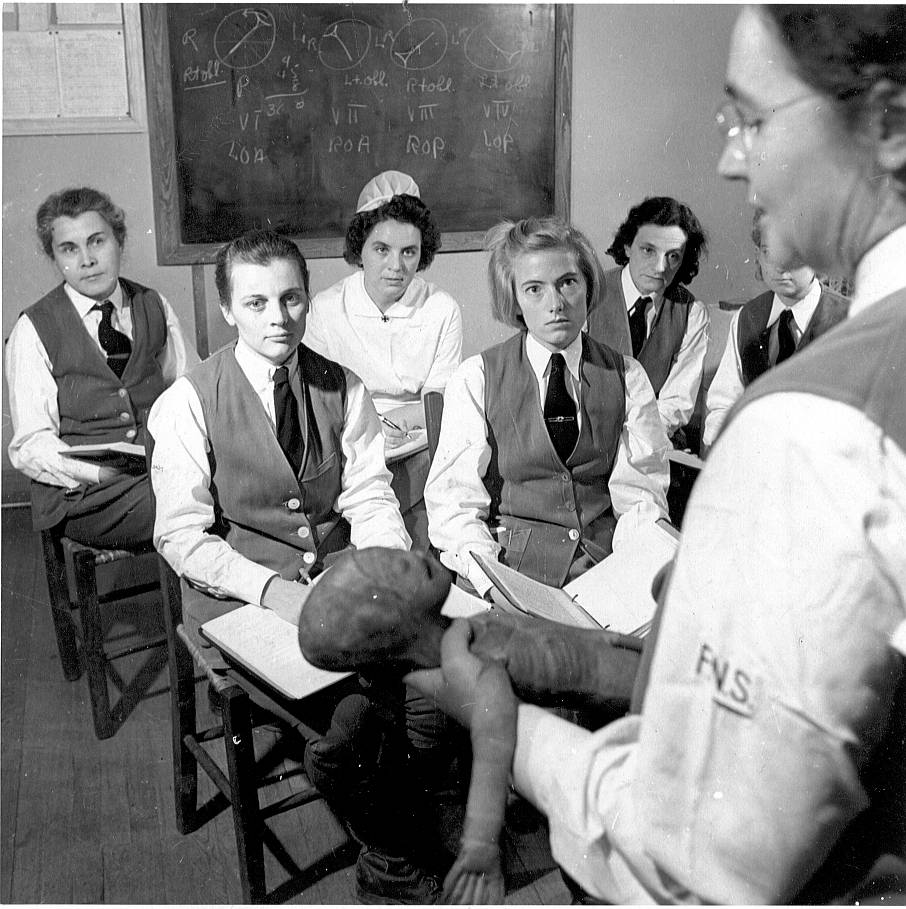
The FNS lacked a mechanism to replenish its ranks, so opening its own school became a necessity. Quickly navigating obstacles such as shortages of faculty, space, and funds, FNS leaders opened the Frontier Graduate School of Midwifery on November 1, 1939, just two months after England entered the war. The school grew slowly but steadily during the war years, having begun with two students in the first class. The program expanded in 1940, increasing the number of students to three. FNS leaders came to count on their graduates to staff the service. With two classes per year, this gave the school the potential to have six new midwives per year to staff the service, a small but realistically sustainable number for the tiny new school.
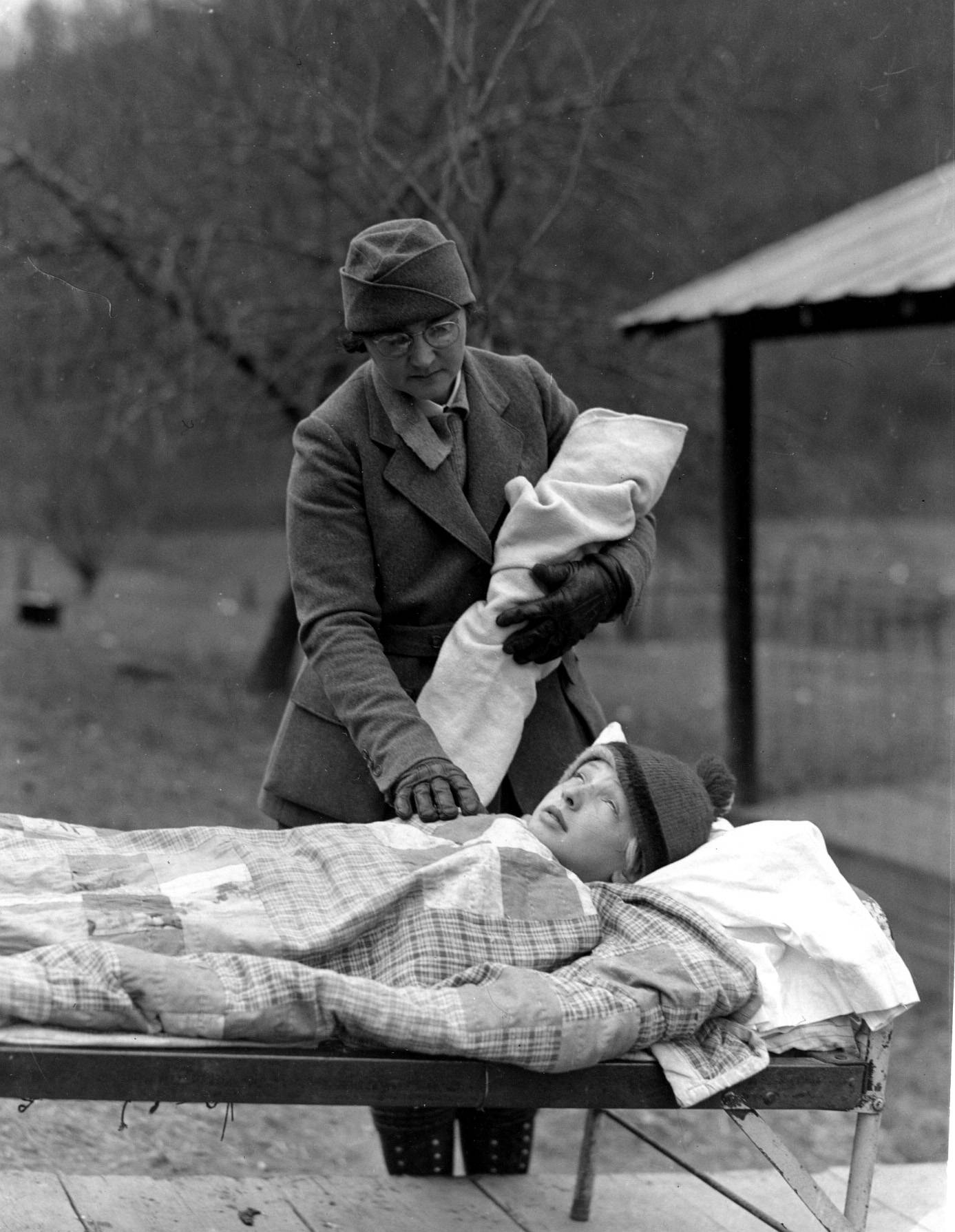
Studying midwifery on the rural frontier attracted students looking for adventure but required flexibility and adaptiveness for students and instructors. Student recollections from the initial decades of the school’s existence are chock full of dramatic stories illustrating the environment in which they worked and learned in eastern Kentucky. Given the steep and snow-covered mountain trails, flood-swollen creeks, and rutted roads, many areas were only navigable on horseback. One early graduate recalled pushing away her anxiety as she negotiated the treacherous paths on a dark and icy night. The horses were shod with ice nails and, on the way to a birth, the supervisor’s horse ahead of her gave off sparks. This sight helped the student feel reassured that, although she couldn’t see her supervisor’s horse ahead of her, it was there. The sure-footed horses also helped the nurses navigate the miles of trails, sometimes swimming across the swiftly flowing rivers that lay between the nurses and the patients’ homes.
Major Changes for the FNS Community at Midcentury
Significant societal shifts during the 1950s and 1960s dramatically affected the experiences of Frontier nurses and graduate students and changed the lives of the individuals and families the FNS served. These shifts required FNS leaders, staff, and students to redouble their efforts to remain flexible and adaptive as they continued to serve the community.
Physician unavailability continued to plague the FNS, and nurses sometimes provided care without a service Medical Director or any other physician whom the nurses could summon in an emergency. To handle problems, nurses often relied solely on written standardized protocols, termed Medical Routines, and consulted with the physician afterward, long after the situation had been resolved. The lengthy 1958 search for a medical director demonstrated that the challenges were not solely due to physicians’ choices about where to live: the norms of physician training practices by midcentury evolved to be misaligned with medical practice in rural areas. FNS leaders conveyed to readers of the Autumn 1958 Quarterly Bulletin that “No doctor can be responsible for a rural hospital and vast field of work who has not had residencies in either surgery or obstetrics-gynecology. [The] trend toward early specialization…is so marked today that doctors who have had as much as two years residency in either surgery or obstetrics-gynecology want to carry on with the specialty and go to the cities…”
Another major societal shift that affected the daily lives of FNS nurses and community members was the transition from home to hospital births. Nationwide, this trend had been increasing throughout the twentieth century. FNS leaders and nurses had resisted the national trends and continued to encourage home birth in specific circumstances. However, around midcentury, the number of FNS home births dropped dramatically. Diminishing home births changed the nurses’ and students’ routines by spending more time at the hospital and less time in patients’ homes. As time went by, students cherished the increasingly rare opportunity to attend a home birth: a 1966 graduate recalled that she was one of only two students in her class who was able to attend a home birth.
Increasingly widespread use of contraception represented another change during the 1960s that affected the lives of FNS patients and students. Reflecting the nationwide birth control movement, FNS leaders established an official family planning program in 1961 with access to oral contraceptive pills and intrauterine contraception. In a short time, the average size of families in the FNS territory decreased markedly and Leslie County’s birthrate decreased by almost 50% between 1959 and 1968. FNS publicity materials of the time reported, “The Medical Director and the nurse-midwives conduct a family planning program which is well accepted by the community and shows excellent results. The pill and IUDs are used successfully, resulting in a lowered birth rate in a county which, up until very recently, had one of the highest birth rates in the country. The parents of today are happily learning to space their children.” The decreased birth rate resulted in an unintended consequence for the FNS: fewer births for FNS nurses to attend and more difficulty for midwifery students in obtaining the requisite number of births to complete their course of study. This shift would lead to a major upheaval in the Frontier graduate school in upcoming years.
Family Nurse Practitioner Education
In the mid-1960s, nursing education and practice changes elsewhere in the nation would result in major effects on the FNS graduate school. In Colorado, Loretta Ford and Dr. Henry Silver founded a novel education program to prepare nurses to provide advanced nursing care of children as pediatric nurse practitioners. FNS nurses immediately recognized Ford and Silver’s model of care because FNS nurses had been providing this type of advanced nursing care for four decades. In addition to maternity care, FNS staff and students had been caring for all members of families through acute and chronic illnesses, injuries, and preventive care needs. Skilled in applying the Medical Routines, FNS nurses knew when care fell within their training and when consultation with or referral to a physician was indicated.
Thus, when FNS leaders learned of the pediatric nurse practitioner education program, they immediately considered adding a nurse practitioner education program at Frontier. A family nurse practitioner program was aligned perfectly with the FNS mission to improve the health of rural-dwelling individuals and families. After a management consultant firm studied the issue in 1969, the firm recommended that the FNS graduate school expand its offering to include comprehensive family nursing.
Planning and implementation proceeded quickly. Helen Browne described the aim of the family nursing programs: “to develop the team approach with the physician and the nurse working closely together so that the families would have well-coordinated continuity of care.” They intended to “bridge the gap that exists between the traditional role of medicine and nursing.” Indeed, as Browne noted, there was “a defined need for a new breed of family nurse practitioners – a sophisticated, knowledgeable, clinically and theoretically oriented group of professionals.” FNS faculty welcomed the first four students into the FNP program on June 15, 1970.
With the addition of the FNP program, the FNS ushered in a new era of growth and service to the community, rural health care, and the nursing profession. As the first FNP students began their studies, the name of the school changed from the Frontier Graduate School of Midwifery to the Frontier School of Midwifery and Family Nursing (FSMFN) to reflect its broadening educational role. As the school catalog noted, the FNP would be “a blending of nursing with selected medical and public health functions.” The traditional nursing role would be expanded to include “basic diagnostic, treatment and preventive skills . . . so that FNPs would be able to provide assistance to families, whether they be living in Appalachia, inner cities or developing countries. . .” The new program fit with the school’s original mission. During the 1970s, the FNP program grew rapidly, and applicants sometimes waited more than a year to be accepted because of the sheer number of nurses interested in a combined midwifery/FNP program or one of the two tracks.
Next: Pressing Need for an Innovative Educational Shift and Frontier in the 21st Century