By Anne Z. Cockerham, PhD, CNM, WHNP-BC, CNE, FACNM Frontier Nursing University Professor
“We have come a long way since our work began…We hitched our wagon to a star then, and when we traded wagons for trucks, we held on to the star. The heart of our work has lain in its start with things as they were and its acceptance of the laws of growth. In planning for future growth, the Frontier Nursing Service still adheres to the principles that gave it being.”
Mary Breckinridge wrote the words above in her autobiography, Wide Neighborhoods, describing the evolution of the Frontier Nursing Service. A key factor in the service’s success had been pragmatism and a willingness to change when circumstances dictated, all while holding on to the star of the service’s core mission. Although Wide Neighborhoods was published only a few decades after the founding of the Frontier Nursing Service, the sentiment holds true today as we celebrate the service’s 100th anniversary.
In this article, we explore the Frontier Nursing Service’s history from 1925 to 2025 through a chronological journey, highlighting the enduring themes that capture both the core mission that FNS stakeholders have consistently embraced, and the many ways that the service has changed. Indeed, whether we examine FNS leaders’ and staff members’ goals and accomplishments in the early years or recent years, we see throughlines of a focus on rural health, a dedication to primary care of the family, a commitment to graduate education of nurse-midwives and nurse practitioners, and flexibility and adaptiveness in navigating obstacles.
The First Decade of the Frontier Nursing Service
From its start in 1925, the Frontier Nursing Service prioritized rural health care. Mary Breckinridge had sought a remote service area for her health care project, largely due to the enormous unmet needs of rural-dwelling people. Reformers had focused on improving the health of city dwellers, particularly urban children, during the Progressive Era years of 1890-1920, but as Breckinridge pointed out, “remotely rural children had been neglected.”
Although FNS leaders and staff were deeply committed to caring for rural people, the remote nature of the service area created challenges. Frontier nurses faced extreme difficulties, including obstacles to reaching and caring for their patients given the treacherous mountainous terrain, unpredictable weather, a nearly nonexistent road network, access to clean water, and adequate lighting. The FNS’s rural setting also limited access to physicians to care for patients with complicated medical needs. Few doctors chose to live and work in such a remote area. Scott Breckinridge, Mary Breckinridge’s cousin and prominent physician, provided several reasons in a 1931 letter to the editor of the Lexington newspaper: “The raising of the standards of medical education and the increasing need of laboratory and hospital facilities for the satisfactory practice of medicine creates difficulties persuading qualified practitioners to locate in isolated communities where those facilities are lacking and where the returns for the services rendered are, at best, most meager.”

A rural focus conferred important advantages as well as challenges for the FNS. Remoteness contributed to an image of the service that enhanced fundraising and staff recruiting. A romanticized version of the FNS’s rural environment allowed potential donors and staff members to return vicariously to an idyllic, bygone era. In fact, Breckinridge referred to her trips between remote eastern Kentucky and the large cities when she attended meetings of the volunteer committees as “commuting between centuries.” The rugged, rural eastern Kentucky setting also appealed to some nurses who longed to be a famed “nurse on horseback” in a rustic and natural mountain setting. To recruit adventure-minded nurses, Breckinridge penned colorful articles intended for young, public health-focused nurses in the American Journal of Nursing and women’s magazines. Prospective nurses also consumed dramatic tales of nursing care in the Kentucky mountains in publications such as journalist Ernest Poole’s widely read 1932 book Nurses on Horseback.
From the earliest years, FNS leaders and staff maximized flexibility and developed strategies to cope with the rural setting and other challenges. Gaining insight from rural health providers in other areas of the world, such as the Highlands and Islands Medical and Nursing Service in Scotland, FNS leaders designed a specific geographic distribution of staff and facilities. Breckinridge explained, “The principle of organization in a remotely rural field of work is one of decentralization. In such a country time and not mileage is the factor involved in daily travel and in all emergencies. It is not a question of the patient’s distance from his nurse but of how long it takes her to reach him.” By delineating districts with the nurse at the center and considering natural arteries of travel, nurses could generally reach any patient in the district by horseback in less than an hour.
 FNS leaders developed the Courier Service as a creative and adaptive strategy to address another challenge, nearly constant budgetary shortfalls. Couriers played an important part in keeping the FNS solvent and running smoothly. Many couriers were college-aged daughters and nieces of FNS donors and committee members and stayed on-site for 6-8 weeks, volunteering their time to care for horses, ferry messages and supplies, escort visitors around the FNS territory, assist nurses, and much more. The couriers’ work benefited the FNS by providing thousands of hours of unpaid work each year. Additionally, former couriers became lifelong advocates for Frontier, an even more far-reaching benefit of the courier program. Seeing the service’s work up close allowed the couriers to return home as effective ambassadors for the Frontier Nursing Service and to tell their friends and family members of the work being done in Kentucky. Couriers took the FNS message out of the mountains and strengthened long-lasting ties between donors and the FNS.
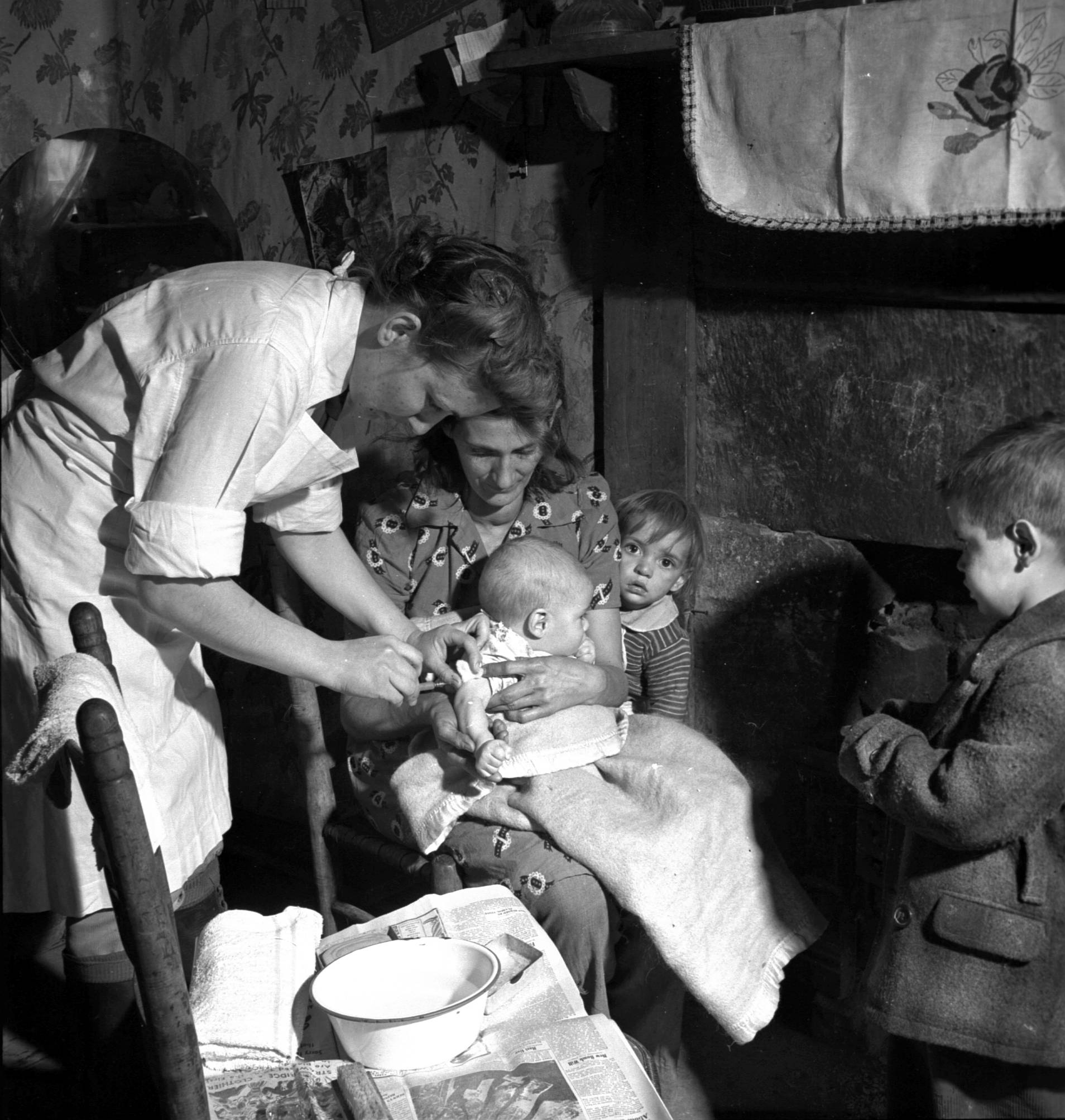
Although Breckinridge founded the Frontier Nursing Service for the initial purpose of caring for mothers and babies, the pressing need to care for the entire family became apparent immediately. Primary care and public health initiatives quickly rose to the same level of importance as maternal-child care. Before the FNS established itself in the area, community members had little access to modern systems of acute or preventive care. FNS nurses quickly set up comprehensive public health programs focused on sanitation, vaccination, health education, and care for many types of illnesses and injuries. The health care needs were great as individuals and families suffered from the effects of numerous infectious diseases such as typhoid fever, dysentery, measles, scarlet fever, whooping cough, tuberculosis, pneumonia, and hookworm. Families, especially children, suffered from malnutrition and vitamin deficiencies because their diet was generally limited to what they could grow, raise, or hunt. Other serious health concerns included injuries from logging and mining accidents, snakebites, gunshot wounds, and more.
Part 3: Pressing Need for an Innovative Educational Shift and Frontier in the 21st Century