
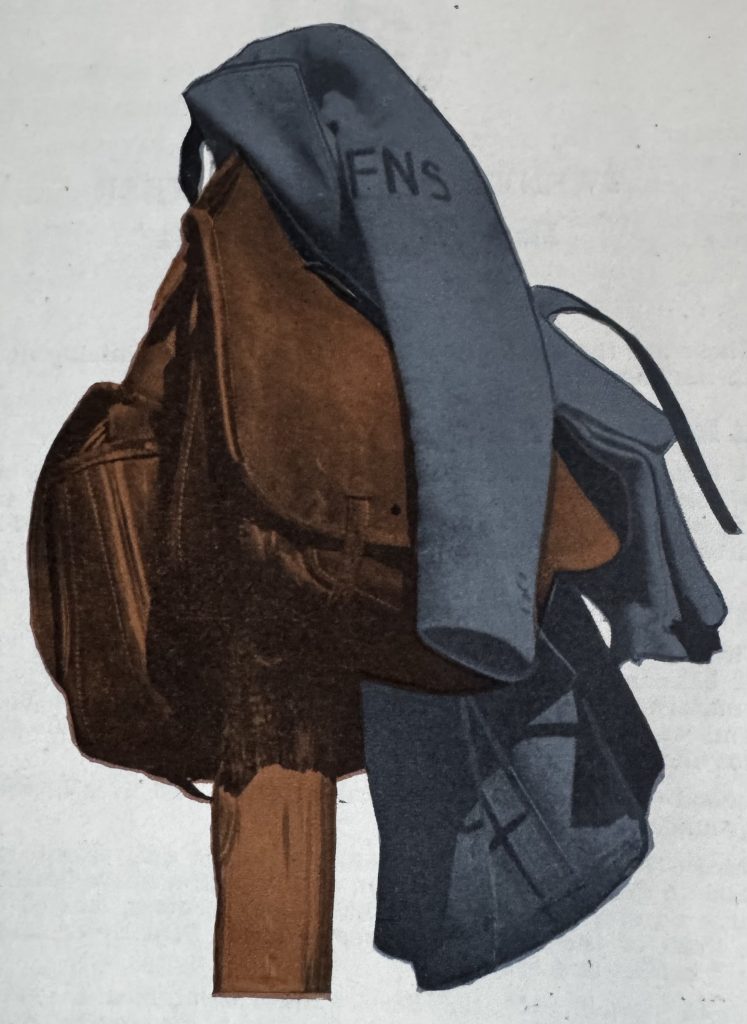
The Frontier Nursing Service (FNS), whose nurses were known as the “nurses on horseback”, is an important part of the history of nursing and nurse-midwifery, and the history of the Southern Mountaineers. The nurses traveled alone by horseback to provide care to families often located miles away in some of the most remote and rugged areas of the Appalachian Mountains in southeastern Kentucky. They provided care for illnesses, injuries, births, and routine health visits relying solely on the limited medications and equipment in her saddlebags, their clinical expertise and creativity, and the assistance of the families they visited.
The Saddlebags: Icon of the FNS
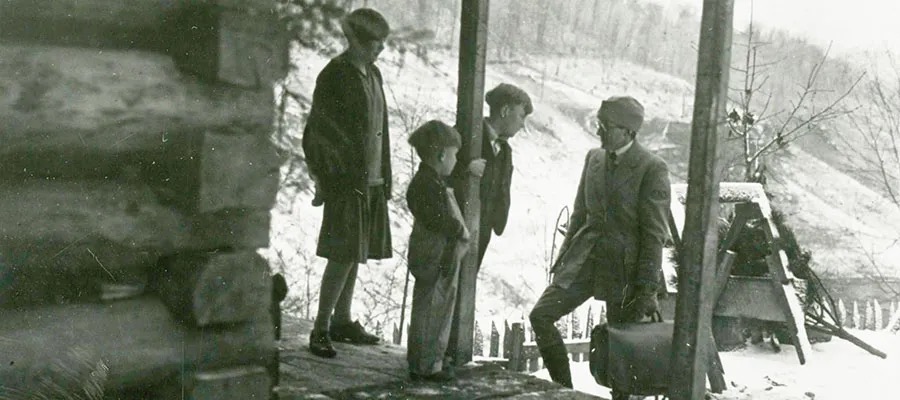
The nurses’ leather saddlebags became an enduring symbol of the FNS. The saddlebags were adapted from the public health nurse’s black leather, hard-sided, rectangular bag, which was used to carry supplies, medications, and equipment to visit people in homes primarily in urban areas that could be reached by foot, streetcar, or automobile. In the FNS service area, there were almost no roads and travel was by horse, so a standard public health nurse’s bag would have been impractical. Instead, a saddlebag was used to carry their supplies. The saddlebags weighed approximately 42 pounds and had to be carefully balanced so that the weight of the bags would not harm the horse or the nurses who often had to carry the saddlebags over their shoulders for part of the journey.

crossing a swinging bridge
with her saddlebags over her shoulder.
Initially, the FNS attempted to use Army surplus saddlebags, but the bags were too small, so the FNS found a local craftsman who made saddlebags by hand. He used the softest leather available to protect the horses and nurses and created roomy bags that could hold all the nurses’ supplies. The saddlebags were shaped so that the supplies would stay upright and not break or get wet and had metal buttons inside that were used to fasten the linings for the bags. The bags cost $13 a pair.
In addition to medications, supplies, and equipment, at the bottom of the saddlebags was a portable stove and a can of Sterno that could be used to boil water, sterilize instruments, or warm supplies. The saddlebags also contained emergency supplies for the horses such as horseshoe nails, rawhide strips, and rope. The saddlebags always contained a copy of the FNS ‘Medical Routines’, which dictated the treatment for all illnesses, injuries, and pregnancy, birth, postpartum, and infant care. In the pocket of the saddlebags was a detailed map of the FNS service area that had been printed on linen so that it could be easily folded and retrieved.
The nurses practiced strict medical asepsis to prevent contamination of their supplies when removing or putting anything into the saddlebags. The saddlebags were organized so that everything needed for a particular type of visit was located together, thereby minimizing the number of times the nurse had to reach into the bag. After visiting a patient or attending a birth, the nurses sanitized their supplies before returning them to their saddlebags. When the nurses returned to the nursing center, they restocked their bags so they were ready to go at any time, and there were many times when a nurse was called to a birth more than once during a night.
Each nurse had two sets of saddlebags: one for general nursing and one for midwifery. The general nursing bag was carried on their daily rounds and contained the equipment and medications needed to see people with illnesses and injuries as well as visiting healthy people such as infants, children, prenatal, and postnatal cases. The nurses also carried a small midwifery kit of emergency supplies to attend a birth if one occurred when they were out on their general rounds.
The midwifery bags were specifically organized to contain everything needed to attend a birth. The midwifery bags were separate from the general nursing bags because the bags had to be kept as clean as possible and away from people with illnesses and infections. A charming anecdote illustrates the cultural impact of the saddlebags. When the mountain children asked where babies came from, they were told that the nurse brought the baby in her saddlebags. The story made sense to the children, who saw the nurse arrive with her saddlebags and then there was a new brother or sister in the home.
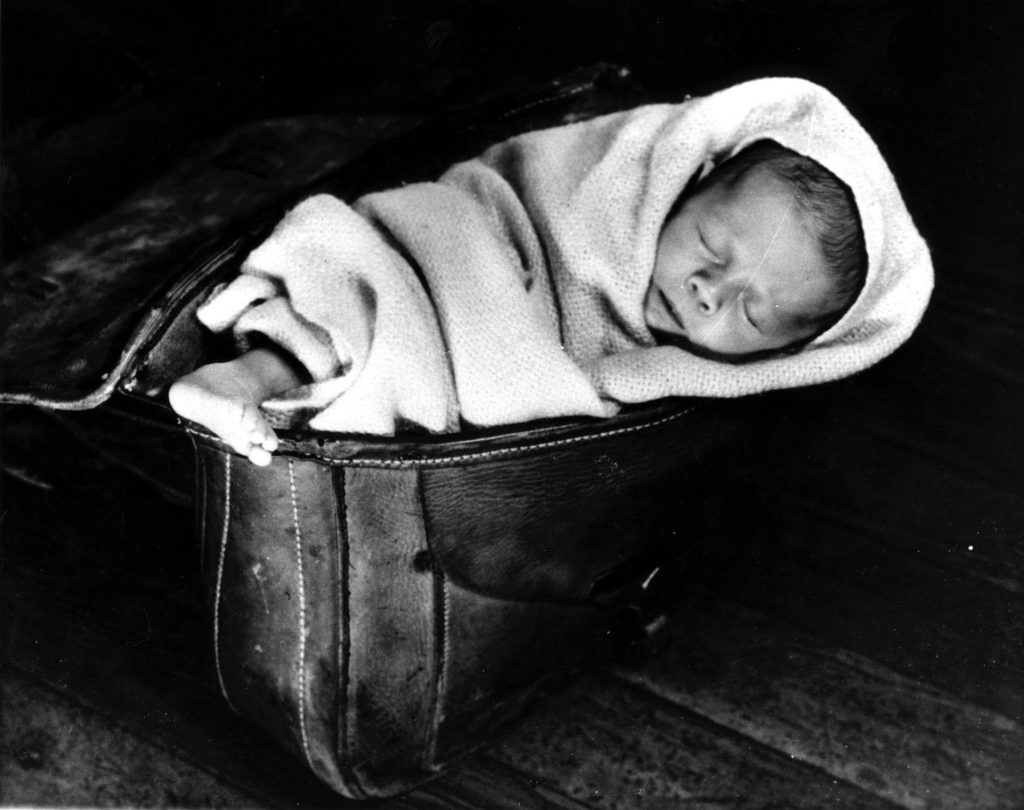
The nurses continued to use their saddlebags when jeeps were introduced to the FNS in 1945. The change from using saddlebags to medical bags to carry equipment was slow. The FNS never wasted anything, and the saddlebags had been perfectly designed for the equipment needed for general nursing care and home births. The jeeps often left the nurse further from the home than a horse would, and the nurses still had to carry their supplies part of the way, so they continued to use their saddlebags for years after motorized vehicles were available. Eventually, however, most visits were made by jeep and when the saddlebags wore out, they were replaced with medical bags.
The Uniforms and Boots: The Iconic Image
The blue uniforms and black boots of the FNS created an iconic image of the “nurses on horseback”. Uniforms are an important part of a profession’s image and represent the high standards of the profession and the organization that employs the person who wears their uniform. Thus, the FNS was fastidious about their nurses’ appearance. Tidiness, cleanliness, and a carefully worn uniform were essential. In addition to a neat and clean uniform, the nurses were not allowed to smoke cigarettes while in uniform, even though tobacco was grown in the area and was bartered for nursing services.
The FNS uniforms were also an important part of the nurses’ identity and credibility. Uniforms identify the wearer as someone committed to serving others, a characteristic that requires respect. The uniform also served to identify the nurse to the community as a trustworthy, licensed health professional employed by the Frontier Nursing Service. The uniform also protected the nurses, making them recognizable to community members far and wide. If a nurse ever had trouble on the trail, people knew that she was a Frontier nurse and would help the nurse as needed, and no FNS nurse was ever harmed by a community member. Indeed, the uniforms allowed nurses to travel anywhere in the mountains, day or night without fear of harm. Uniforms can also unify a professional group, making its members recognizable to each other and conveying a sense of belonging, which was important for the FNS nurses since they worked in such remote areas and were separated from their own families and friends.
Mary Breckinridge, the founder of the FNS, understood the importance of uniforms, first having worn a uniform as a student nurse and later when working with the American Committee for Devastated France whose work involved the rebuilding of one of the most war-damaged sections of northern France after World War I. The uniforms identified committee members as people who could be trusted to help community members, and Breckinridge adopted the color, fabric, and styling of their blue-gray wool uniforms for the FNS winter uniform. Breckinridge also had the opportunity to observe the appearance, wearability, and utility of the uniforms of the British District nurses and the district nurse-midwives in the Scottish Highlands and Islands.
The FNS uniforms were designed for riding by horseback to make visits to patients in their homes or at community centers. The FNS uniforms were unique in that the nurses wore riding breeches at a time when dresses and skirts were the standard apparel for women. However, during World War I, nurses stationed in cold climates began wearing Army breeches under their skirts, and public health nurses soon reported doing the same in the early 1920s. At the same time, the practicality and safety of allowing women to ride astride horses was recognized and riding breeches for women became available.

uniform and carrying her
saddlebags over her shoulder.
The FNS uniforms also provided comfortable and sturdy clothing needed to ride by horseback on ungroomed trails over mountains, through forests, and across rivers to reach their patients. The bluegray wool winter uniform and cap kept the nurses warm when traveling in ice and snow, and the lighter blue cotton summer uniform kept them cooler in the summer heat and humidity. The uniforms protected the nurses from weather and the environment. The uniforms also protected the patients. When a nurse entered a home, she removed her jacket, rolled up the sleeves of her white shirt, and carefully scrubbed her hands and arms with soap and clean water. Then, the nurse covered her clothing with a clean white apron.
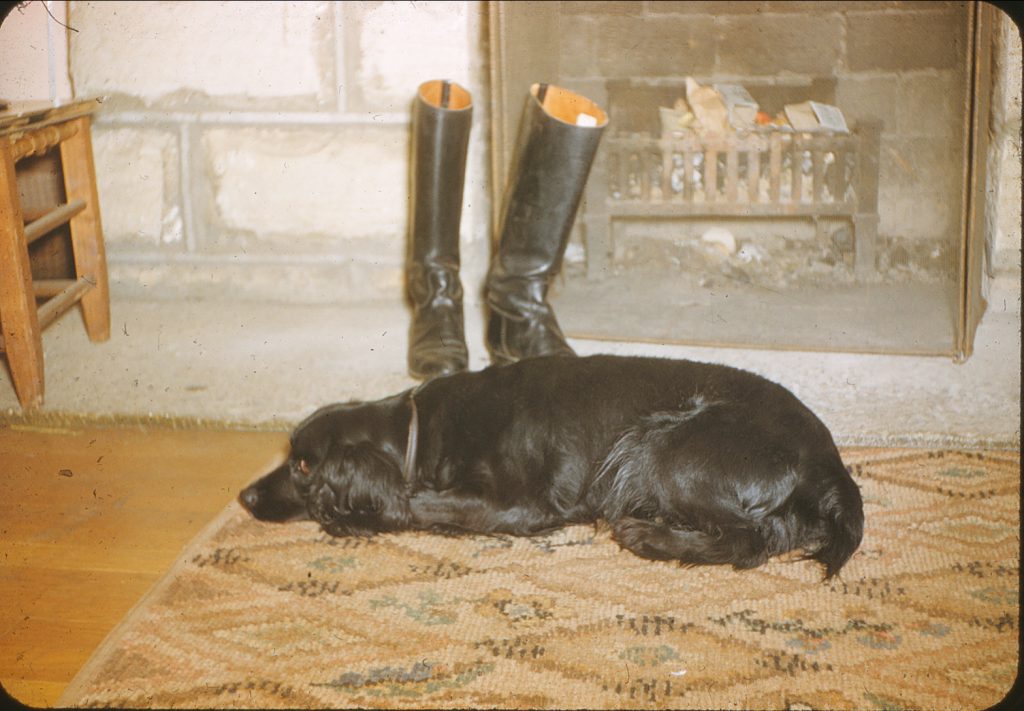
Boots were an essential part of the nurses’ uniform. Traveling by horseback or on foot meant the nurses had to ride or walk through water, mud, rocks, and brush to reach their patients. The knee-high boots kept the nurses’ feet and legs warm and dry, and protected them from injury and snake bites. The boots also protected the nurses’ legs from the saddle and stirrup straps. Once on, the boots were worn throughout the workday at the nursing center, during home visits, births, and field work until the nurse returned home.
Legacy of the Uniforms, Boots, and Saddlebags
Although the uniforms and boots of the Frontier Nursing Service have been replaced by scrubs, lab coats, and athletic footwear, the image of the saddlebags lingers. The nurse and her saddlebags saved countless lives and improved the health of families throughout southeastern Kentucky. It behooves us to reimagine those saddlebags and what current students, alumni, and faculty might carry in them; not equipment, not supplies, and not medications; those are readily available elsewhere. Instead, our modern community fills their personal saddlebags with a culture of caring, the evidence for practice, commitment to health equity, and access to healthcare in rural and underserved areas. Most importantly, we carry the image of the nurses on horseback who were fearless in their desire to provide healthcare regardless of the circumstances, that challenges us all to think about how we can provide healthcare in the most difficult of circumstances.
Our modern community fills their personal saddlebags with a culture of caring, the evidence for practice, commitment to health equity, and access to healthcare in rural and underserved areas.
This article was original published in the Spring 2026 Quarterly Bulletin and was written by:
Janet L. Engstrom, PhD, APRN, CNM, WHNP-BC, CNE
Joanne M. Keefe, DNP, MPH, APRN, FNP-c, CNE
Anne Z. Cockerham, PhD, APRN, CNM, WHNP-BC, CNE

















 Carrie Belin is an experienced board-certified Family Nurse Practitioner and a graduate of the Johns Hopkins DNP program, Johns Hopkins Bloomberg School of Public Health, Georgetown University School of Nursing, and Johns Hopkins School of Nursing. She has also completed fellowships at Georgetown and the University of California Irvine.
 Angie has been a full-scope midwife since 2009. She has experience in various birth settings including home, hospital, and birth centers. She is committed to integrating the midwifery model of care in the US. She completed her master’s degree in nurse-midwifery at Frontier Nursing University (FNU) and her Doctorate at Johns Hopkins University. She currently serves as the midwifery clinical faculty at FNU. Angie is motivated by the desire to improve the quality of healthcare and has led quality improvement projects on skin-to-skin implementation, labor induction, and improving transfer of care practices between hospital and community midwives. In 2017, she created a short film on skin-to-skin called









 Justin C. Daily, BSN, RN, has ten years of experience in nursing. At the start of his nursing career, Justin worked as a floor nurse on the oncology floor at St. Francis. He then spent two years as the Director of Nursing in a small rural Kansas hospital before returning to St. Francis and the oncology unit. He has been in his current position as the Chemo Nurse Educator for the past four years. He earned an Associate in Nurse from Hutchinson Community College and a Bachelor of Science in Nursing from Bethel College.
 Brandy Jackson serves as the Director of Undergraduate Nursing Programs and Assistant Educator at Wichita State University and Co-Director of Access in Nursing. Brandy is a seasoned educator with over 15 years of experience. Before entering academia, Brandy served in Hospital-based leadership and Critical Care Staff nurse roles. Brandy is passionate about equity in nursing education with a focus on individuals with disabilities. Her current research interests include accommodations of nursing students with disabilities in clinical learning environments and breaking down barriers for historically unrepresented individuals to enter the nursing profession. Brandy is also actively engaged in Interprofessional Education development, creating IPE opportunities for faculty and students at Wichita State. Brandy is an active member of Wichita Women for Good and Soroptimist, with the goal to empower women and girls. Brandy is a TeamSTEPPS master trainer. She received the DASIY Award for Extraordinary Nursing Faculty in 2019 at Wichita State University.
  Dr. Sabrina Ali Jamal-Eddine is an Arab-disabled queer woman of color with a PhD in Nursing and an interdisciplinary certificate in Disability Ethics from the University of Illinois Chicago (UIC). Dr. Jamal-Eddine’s doctoral research explored spoken word poetry as a form of critical narrative pedagogy to educate nursing students about disability, ableism, and disability justice. Dr. Jamal-Eddine now serves as a Postdoctoral Research Associate in UIC’s Department of Disability and Human Development and serves on the Board of Directors of the National Organization of Nurses with Disabilities (NOND). During her doctoral program, Sabrina served as a Summer Fellow at a residential National Endowment of the Humanities (NEH) Summer Institute at Arizona State University (2023), a summer fellow at Andrew W. Mellon’s National Humanities Without Walls program at University of Michigan (2022), a Summer Research Fellow at UC Berkeley’s Othering & Belonging Institute (2021), and an Illinois Leadership Education in Neurodevelopmental and related Disabilities (LEND) trainee (2019-2020).
 Vanessa Cameron works for Vanderbilt University Medical Center in Nursing Education & Professional Development. She is also attending George Washington University and progressing towards a PhD in Nursing with an emphasis on ableism in nursing. After becoming disabled in April 2021, Vanessa’s worldview and perspective changed, and a recognition of the ableism present within healthcare and within the culture of nursing was apparent. She has been working since that time to provide educational foundations for nurses about disability and ableism, provide support for fellow disabled nursing colleagues, and advocate for the disabled community within healthcare settings to reduce disparities.
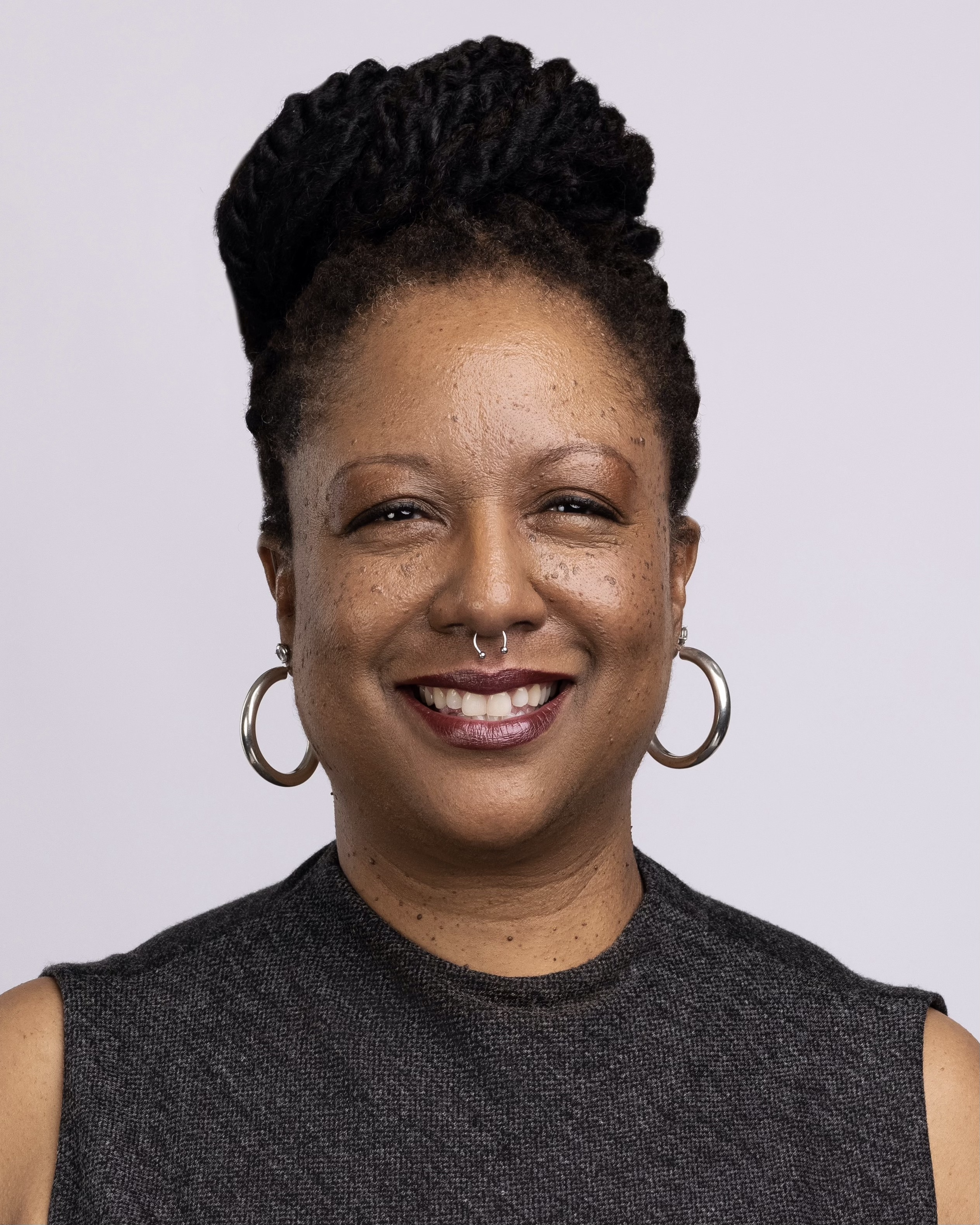 Dr. Lucinda Canty is a certified nurse-midwife, Associate Professor of Nursing, and Director of the Seedworks Health Equity in Nursing Program at the University of Massachusetts Amherst. She earned a bachelor’s degree in nursing from Columbia University, a master’s degree from Yale University, specializing in nurse-midwifery, and a PhD from the University of Connecticut. Dr. Canty has provided reproductive health care for over 29 years. Her research interests include the prevention of maternal mortality and severe maternal morbidity, reducing racial and ethnic health disparities in reproductive health, promoting diversity in nursing, and eliminating racism in nursing and midwifery.
 Dr. Lisa Meeks is a distinguished scholar and leader whose unwavering commitment to inclusivity and excellence has significantly influenced the landscape of health professions education and accessibility. She is the founder and executive director of the DocsWithDisabilities Initiative and holds appointments as an Associate Professor in the Departments of Learning Health Sciences and Family Medicine at the University of Michigan.
 Dr. Nikia Grayson, DNP, MSN, MPH, MA, CNM, FNP-C, FACNM (she/her) is a trailblazing force in reproductive justice, blending her expertise as a public health activist, anthropologist, and family nurse-midwife to champion the rights and health of underserved communities. Graduating with distinction from Howard University, Nikia holds a bachelor’s degree in communications and a master’s degree in public health. Her academic journey also led her to the University of Memphis, where she earned a master’s in medical anthropology, and the University of Tennessee, where she achieved both a master’s in nursing and a doctorate in nursing practice. Complementing her extensive education, she completed a post-master’s certificate in midwifery at Frontier Nursing University.








 Dr. Tia Brown McNair is the Vice President in the Office of Diversity, Equity, and Student Success and Executive Director for the Truth, Racial Healing, and Transformation (TRHT) Campus Centers at the American Association of Colleges and Universities (AAC&U) in Washington, DC. She oversees both funded projects and AAC&U’s continuing programs on equity, inclusive excellence, high-impact practices, and student success. McNair directs AAC&U’s Summer Institutes on High-Impact Practices and Student Success, and TRHT Campus Centers and serves as the project director for several AAC&U initiatives, including the development of a TRHT-focused campus climate toolkit. She is the lead author of From Equity Talk to Equity Walk: Expanding Practitioner Knowledge for Racial Justice in Higher Education (January 2020) and Becoming a Student-Ready College: A New Culture of Leadership for Student Success (July 2016 and August 2022 Second edition).